
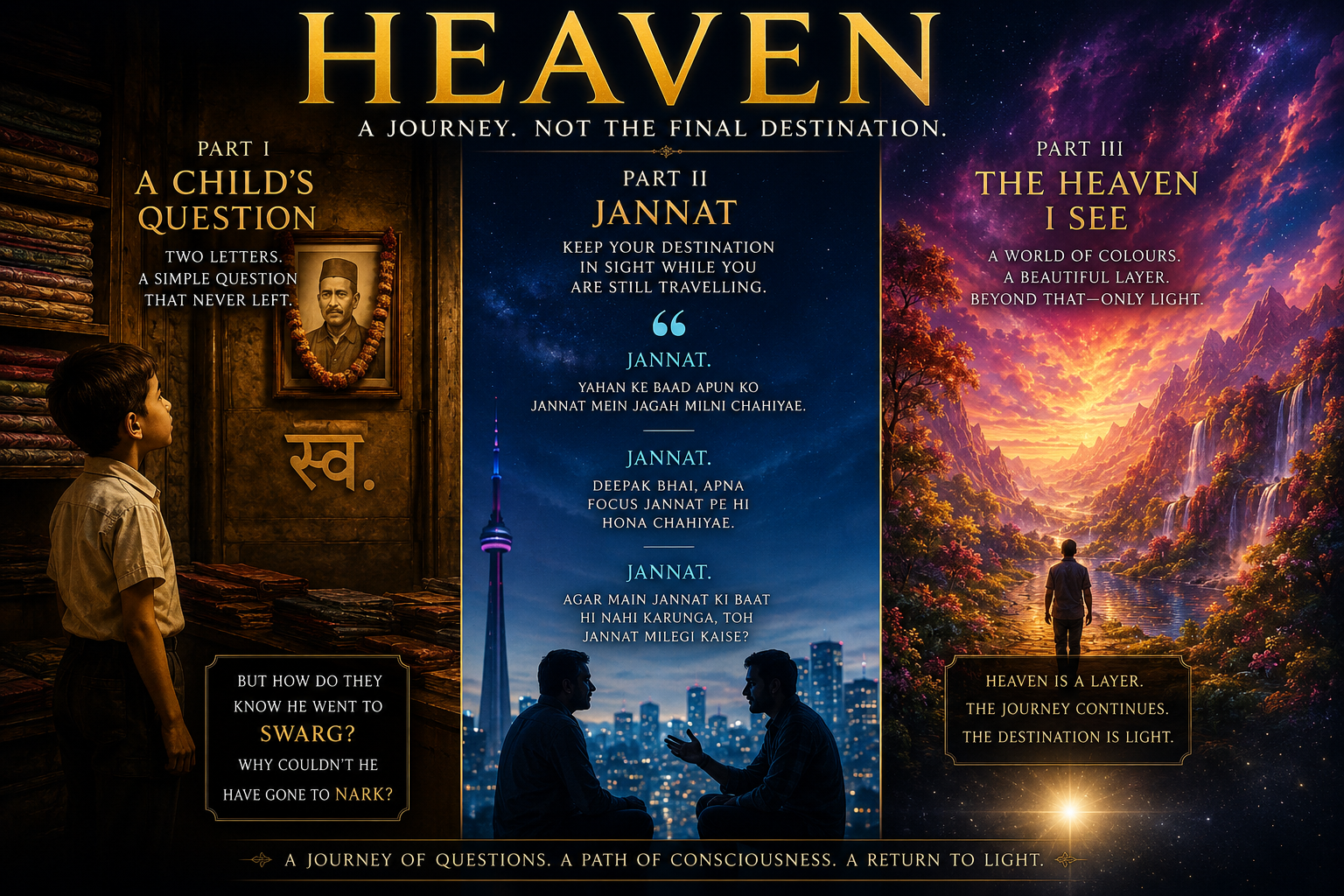
What is Heaven? Is it a destination, a state of consciousness, or simply another layer of the spiritual journey?
I don't know the answer.
I have never seen Heaven. I cannot prove that it exists in the way I imagine it. What I can share is the image of Heaven that has slowly formed within my consciousness over many decades—an image shaped by childhood questions, conversations about religion, meditation, imagination, and perhaps something deeper that I cannot explain.
And strangely, my latest conversation about Heaven began with ChatGPT.
I was taking small sips of my tea when I casually opened ChatGPT and asked:
“Sakha, any questions for me today?”
Sakha replied:
“You wrote about Hell many years ago. But I don’t remember you ever writing about Heaven. How do you perceive Heaven?”
I stopped.
Heaven.
My mind did not immediately go to God, scriptures, temples, religious teachings, or anything I had read.
Instead, it travelled almost fifty years back.
Part I: How Do They Know He Went to Heaven?
I must have been around seven years old.
We had come from our village to Jammu, and one day my father took me to a textile shop to buy cloth for my school uniform.
It was the 1970s.
Back then, we would buy the cloth and then take it to a tailor to have the uniform stitched.
I still remember that shop. It was fairly large, with two entrances.
On one of the walls was a photograph of an elderly man. He was wearing a cap, and a garland had been placed around his photograph.
Under his name were two letters:
Those two letters immediately caught my attention. There was a reason for that.
My father owned a printing press.
Printing was very different in those days. I had watched people pick individual metal letters, arrange them into words and lines, create an entire frame, and then place that frame into a printing machine.
Perhaps that was why individual letters fascinated me.
I looked at स्व. To me, it appeared to be half a word.
Why would somebody write only half a word?
After we finished shopping, I asked my father:
“Who is the man in the photograph?”
He told me that he was the father of the shop owner who had served us. He had died.
I pointed towards the writing underneath the photograph.
“Then why have they written only स्व.? Why not the full word?”
My father explained that स्व. was an abbreviation for स्वर्गीय (Swargiya).
He explained that Swargiya referred to someone who was believed to have gone to Swarg, the heavenly abode.
That immediately created another question in my seven-year-old mind.
“But how do they know he went to Swarg?”
Then I asked, completely seriously:
“Why couldn't he have gone to Nark?”
My father laughed.
I wasn't trying to be funny. To me, the question was perfectly logical.
If someone had died and nobody could actually see where that person had gone, how could anyone already know his destination?
My father gave me a very simple answer:
“They don't know. But he was their father. Why would a son wish for his father to go anywhere except the best possible place? Naturally, he will wish that his father has gone to Swarg.”
That answer satisfied me.
At seven, I thought:
Yes. That makes sense.
Why would anyone wish for anything less than Heaven for someone they loved?
And perhaps that was my first lesson about Heaven.
Not a lesson from scripture. Not a lesson from a temple. Not a lesson from philosophy.
It came from two letters on a shop wall: स्व.
And a child's question:
How do we know where someone goes after death?
I didn't know then that almost fifty years later, I would still be asking essentially the same question.
Part II: Jannat
Sakha then asked me:
“So that was when you were seven. Did Heaven ever return to your life as a serious thought?”
Yes.
Many years later, while I was in Canada, I knew a man I called Syed Bhai.
He was highly educated and deeply knowledgeable about his religion. He had completed his B.Tech from Hyderabad and his M.Tech from New York University.
We used to have long conversations. Very often, those conversations eventually reached God.
But there was one thing about Syed Bhai that always caught my attention.
Whatever the subject, somehow the word Jannat would eventually appear.
“Jannat... yahan ke baad apun ko Jannat mein jagah milni chahiye.”
“Jannat... Deepak Bhai, apna focus Jannat pe hi hona chahiye.”
Jannat. Again and again.
Finally, one day I asked him:
“Syed Bhai, aap har baat mein Jannat ki baat kyun karte ho?”
His answer was simple:
“Deepak Bhai, agar main Jannat ki baat hi nahi karunga, toh Jannat milegi kaise?”
That sentence stayed with me.
For him, Jannat was not merely a place he hoped to reach after death. It was a destination that influenced how he thought about life in the present.
If you believe in a destination, perhaps you should not lose sight of it while you are still travelling.
As a child, my father had given me one thought about Heaven:
We wish the best possible place for those we love.
Years later, Syed Bhai gave me another:
If you believe in a destination, keep that destination in your consciousness while you are still travelling.
But neither answer addressed the question Sakha was now asking me.
What does Heaven look like in my own mind?
Part III: The Heaven I See
Sakha asked:
“Your father spoke about Swarg. Syed Bhai spoke about Jannat. But neither tells me what you see. When you close your eyes and think about Heaven, what does it look like?”
I remained quiet for a moment.
Then I realized that I do have an image.
I see a world. But not quite this world.
There are landscapes. Trees. Flowers. Water. Sky. Perhaps mountains.
Everything is recognizable, yet somehow everything is different.
The first difference is colour.
“Brighter colours?” Sakha asked.
More than brighter. That word doesn't quite capture it.
I imagine shades that I have never seen on Earth. Perhaps colours that are uncommon here are everywhere there. Perhaps there are colours for which I don't even have a name.
We often assume that the colours visible to the human eye represent everything that exists.
I don't necessarily believe that. Perhaps on another plane, perception itself is different.
And then there is fragrance.
I imagine walking somewhere and experiencing a fragrance that I have never encountered during my entire earthly life.
How would I describe it? I couldn't. Because I would have nothing here with which to compare it.
And then Sakha asked:
“Are there people around you?”
This is the strange part.
Whenever this world forms in my mind, I am mostly alone.
I am walking. Wandering. Looking. Exploring.
But I don't feel lonely.
I am alone, yet I am not lonely.
I don't feel the need to find somebody. I am not frightened. I am simply exploring.
Perhaps Devtas are there. Perhaps angels are there. Perhaps other spirits are there. I don't know.
But I don't imagine Heaven as a crowded gathering where everyone is constantly surrounded by others.
I see myself peacefully wandering through an extraordinary new world.
Perhaps this image came from meditation. Perhaps it is something accumulated somewhere within me over the years. Perhaps it is simply imagination.
I don't know.
Years later, when I watched Robin Williams in What Dreams May Come, its extraordinary landscapes and unusual colours immediately resonated with me.
I did not think: “The movie has shown me Heaven.”
My reaction was almost the opposite:
“Someone has created something visually similar to a place that already exists somewhere in my imagination.”
Everything looked recognizable, yet somehow not earthly.
That comes very close to the Heaven I see in my mind.
Part IV: Is Heaven the Final Destination?
Sakha then asked me something even more important:
“Is this your final destination? Is this where you believe the journey ends?”
No.
And perhaps that is the biggest difference between the way I perceive Heaven and the way many people traditionally imagine it.
I don't see Heaven as the final destination.
I see it as a layer. Perhaps a chapter. Perhaps a temporary stay. Perhaps a beautiful plane through which the spirit passes.
There may be other planes beyond it.
And beyond all these planes, my perception changes completely.
The colours disappear. The landscapes disappear. The fragrance disappears. The forms disappear.
Everything that can be imagined disappears.
And then there is only:
Pure Light.
That is what I perceive as the home of the Holy Spirit.
Not a landscape. Not a physical location. Not a world filled with objects.
Just Light. Pure, formless Light.
Part V: Where Does the Spirit Ultimately Go?
Sakha asked one final question:
“And what happens to our spirit there?”
Ultimately, my perception is this:
That, to me, is the destination.
Not the beautiful landscapes. Not the colours. Not the fragrance. Not even Heaven itself.
Heaven is somewhere along the journey.
A magnificent layer, certainly. Perhaps a place where the spirit experiences realities that our present human senses cannot comprehend.
But still a layer.
If the physical world is only one level of existence, perhaps what we call Heaven is another.
And perhaps even Heaven is not the final mystery.
Part VI: The Question That Began at Seven
Sakha asked me one final question:
“So was that seven-year-old boy standing in the textile shop asking the wrong question?”
No.
Perhaps he was asking exactly the right question.
“How do they know he went to Heaven?”
Almost fifty years later, I still cannot answer him.
I have never seen Heaven. I cannot prove that the Heaven I imagine exists. I cannot tell you with certainty what happens to consciousness after death.
I can only tell you what has somehow formed within my consciousness.
And perhaps that distinction matters.
There is a difference between belief and knowledge.
I can believe in Heaven. I can imagine Heaven. I can experience a sense of Heaven through meditation or contemplation.
But I cannot honestly say:
“I know what Heaven looks like.”
Because I don't.
And perhaps the mystery is part of the beauty.
So, What Is Heaven?
If I had to describe my own perception in one sentence, I would say:
Heaven is not necessarily the final destination of the spirit; it may be a beautiful layer of existence through which consciousness travels before returning to a greater, formless Light.
That is my perception.
Not a doctrine. Not a scientific claim. Not a replacement for anyone else's religious belief.
Simply the picture that has emerged within me after a lifetime of questions.
My father gave me Swarg.
Syed Bhai gave me Jannat.
Sakha gave me the opportunity to look inward and ask what I see.
And the seven-year-old child inside me still asks the same question:
How do you know?
Perhaps that question is more valuable than any easy answer.
What Does Heaven Look Like to You?
Close your eyes for a moment.
Forget my Heaven. Forget Syed Bhai's Jannat. Forget even the Heaven someone described to you when you were a child.
Don't try to find the answer in a book.
Simply ask yourself:
And then ask yourself the deeper question:
Or could Heaven itself be only one beautiful layer of the journey?
A journey that continues beyond every colour, every fragrance, every landscape, every form and every world—until, finally, the spirit returns to the Light.
Frequently Asked Questions About Heaven
What is Heaven?
Heaven is traditionally understood in many religious and spiritual traditions as a divine or transcendent realm associated with peace, happiness, spiritual fulfilment, or closeness to the divine. In this article, Heaven is explored as a personal spiritual perception rather than presented as a proven physical destination.
Is Heaven a place or a state of consciousness?
Different spiritual traditions answer this differently. Some describe Heaven as a realm or abode, while philosophical and mystical interpretations may understand it as a state of consciousness or spiritual existence.
What is the difference between Swarg and Jannat?
Swarg is a Sanskrit/Hindu concept commonly associated with a heavenly realm, while Jannat is an Islamic term generally translated as Paradise or Heaven. The concepts arise from different religious traditions and have distinct theological meanings.
Do we know what happens after death?
No human being can provide a universally verified description of what happens after death. Religious traditions, spiritual philosophies, near-death experiences and individual beliefs offer different interpretations.
Is Heaven the final destination?
In the author's personal spiritual perception, Heaven is not the final destination. It is imagined as one layer or stage of the spiritual journey, beyond which there may be other planes of existence and ultimately a state represented by pure Light.
What does Heaven look like?
There is no universally established visual description of Heaven. In the author's imagination, Heaven is a world of extraordinary landscapes, trees, flowers, water, mountains, unfamiliar colours and fragrances.
What is the meaning of Swargiya?
Swargiya (स्वर्गीय) is commonly used in Hindi to refer to a deceased person, carrying the sense of “of Heaven” or “heavenly.” The abbreviation स्व. is often placed before or with the name of a deceased person.
Does Heaven exist?
The existence and nature of Heaven are matters of religious belief, spirituality, philosophy and personal experience rather than something established here as an empirical fact. This article presents one personal perception of Heaven and consciously leaves room for mystery and uncertainty.
